Milestones

Milestones

Milestones

The Beginning of NAWMP

May 1986

The inaugural North American Waterfowl Management Plan (NAWMP), signed in May 1986 by the U.S. Secretary of the Interior and the Canadian Minister of the Environment, marked a historic milestone in international wildlife conservation. This groundbreaking agreement — the first of its kind for migratory birds — emerged in response to alarmingly low waterfowl populations across the continent, forging an unprecedented partnership between Canada and the United States to address shared challenges through coordinated habitat protection, restoration, and enhancement.

Today, this enduring legacy continues to evolve and inspire, as successive updates to the Plan build upon its pioneering principles, strengthening biological goals, fostering broader alliances with other bird conservation initiatives, and guiding successful habitat conservation efforts across North America. The 1986 signing remains a cornerstone achievement, demonstrating the power of unified action to safeguard migratory species for future generations.

North American Waterfowl Management Plan Committee Established

June 1986

A key strength of the NAWMP process has been its strong emphasis on continuity and careful coordination. This approach has empowered wildlife management agencies across North America to successfully implement a wide range of short- and long-term projects that align with the Plan's ambitious and shared goals.

To further enhance these strengths, the North American Waterfowl Management Plan Committee was established as a vital collaborative body. This Committee has played an instrumental role in monitoring progress, guiding updates to the Plan, coordinating ongoing initiatives, and thoughtfully assessing new proposals and joint ventures. It brings together dedicated representatives from federal, state, provincial, and territorial wildlife agencies in Canada, the United States, and Mexico, fostering unprecedented trinational cooperation.

The Committee offers valuable recommendations that are fully aligned with the Plan's scope, helping drive positive outcomes. It operates without regulatory authority and fully respects and complements the established functions of flyway councils in the United States, ensuring efficient and harmonious conservation efforts across the continent.

Migratory Bird Joint Ventures Established

July 1986

In the summer of 1986, just months after the landmark signing of the North American Waterfowl Management Plan (NAWMP) by Canada and the United States in May, a pivotal innovation took flight: the establishment of Joint Ventures in July. These regional partnerships were born as the engine of the Plan, designed to turn ambitious continental goals into tangible, on-the-ground action for reversing the alarming declines in waterfowl populations and their vital wetland habitats.

At their core, Joint Ventures are dynamic collaborations that unite a diverse flock of players — federal and state agencies, provinces, tribes, non-governmental organizations like Ducks Unlimited and Audubon, corporations, and passionate individuals. Operating across key landscapes like the Mississippi Flyway, the Appalachian Mountains, the Prairies, and beyond, they include habitat-focused JVs in the U.S. and Canada, as well as species-specific JVs targeting icons like Arctic geese and black ducks. Think of them as localized powerhouses, aligning with flyway councils to deliver science-driven conservation where it matters most — protecting wetlands, restoring grasslands, and managing threats like woody encroachment to keep ecosystems thriving.

JV Genius

What makes Joint Ventures indispensable to NAWMP's enduring success? Their genius lies in fostering cooperation on a massive scale, bridging borders and sectors to pool resources, expertise, and enthusiasm. By emphasizing partnerships, they've enabled landscape-level strategies that go beyond isolated efforts, addressing the full lifecycle needs of migratory birds — from breeding grounds in the north to wintering habitats in the south. This collaborative model has proven vital for tackling complex challenges, like habitat loss and population declines, while integrating biological, ecological, and social sciences to ensure decisions are smart and sustainable.

The value shines through in real-world wins: Joint Ventures have safeguarded millions of acres, boosted bird populations, and created ripple effects for other wildlife, cleaner water, and human communities that rely on these spaces for recreation and economic vitality. They've kept common species abundant and elevated those at risk, all while building capacity for long-term monitoring and adaptive management.

Without these ventures, NAWMP would be merely a visionary document. With them, it's a living legacy of conservation triumph, proving that united action can secure a brighter future for waterfowl and the wild places they call home.

North American Wetlands Conservation Act (NAWCA) Signed

December 12, 1989

With the help of key legislators like Senator George Mitchell of Maine and Representative Silvio Conte of Massachusetts, the North American Wetlands Conservation Act, or NAWCA, was introduced. In 1989, the Senate and House passed NAWCA, and President George H.W. Bush signed it into law on December 13, 1989. Bush also pledged a new policy of "no net loss of wetlands," marking a bold federal commitment to halting the rapid disappearance of these vital ecosystems across the continent.

Born out of the urgent need to support the fledgling North American Waterfowl Management Plan (NAWMP), NAWCA emerged as a game-changing tool for trinational conservation. The Act authorizes federal grants — administered by the U.S. Fish and Wildlife Service — to fund projects that protect, restore, and enhance wetlands and associated uplands in the United States, Canada, and Mexico. These grants, which require at least a 1:1 match from non-federal partners, catalyze public-private collaborations involving states, provinces, tribes, nonprofits like Ducks Unlimited and The National Audubon Society, private landowners, and even corporations. A nine-member North American Wetlands Conservation Council, including representatives from all three countries, reviews proposals and awards funding twice a year, prioritizing efforts that align with NAWMP's goals for sustainable waterfowl populations and habitats.

Matching and Multipliers

NAWCA's true power lies in its multiplier effect: Since 1991, over $2.28 billion in federal grants have leveraged more than $4.53 billion in matching contributions, fueling over 3,300 projects that have conserved, restored, or enhanced upwards of 32.6 million acres of wetlands and related habitats across North America.

This isn't just about numbers. It's about real, landscape-scale impact. In the U.S. alone, NAWCA has touched every state, safeguarding breeding grounds in the Prairie Pothole Region, wintering refuges along the Gulf Coast, and stopover sites in the Mississippi Flyway. Extending to Canada and Mexico, the Act has funded boreal forest protection, coastal mangrove restoration, and highland wetland conservation vital to migratory routes.

For waterfowl and broader wildlife, NAWCA's value is massive. It has directly bolstered populations of ducks, geese, and swans by preserving the wetlands they depend on for breeding, nesting, feeding, and migration — reversing declines that prompted NAWMP's creation. Beyond birds, these projects benefit over 700 other species, from fish and amphibians to mammals like moose and otters, while filtering pollutants, recharging aquifers, and providing natural buffers against floods and storms. Economically, they support hunting, birdwatching, and outdoor recreation industries worth billions annually, creating jobs and enhancing community resilience. As climate change intensifies threats such as sea-level rise and drought, NAWCA's adaptive, partnership-driven approach ensures ongoing relevance, with recent funding rounds, such as the $102.9 million approved in 2024, continuing to build on this legacy. In essence, NAWCA transformed a visionary plan into an actionable triumph, proving that targeted investment and cross-border unity can secure a thriving future for North America's wetlands and the wildlife they sustain.

Mexico Joins NAWMP: A Landmark Tri-national Milestone

June 1994

In a landmark expansion that truly made the North American Waterfowl Management Plan (NAWMP) a continent-wide endeavor, Mexico joined as a full partner in June 1994, signing onto the Plan's first major update. This step completed the trinational framework, building on initial involvement that began as early as 1988 and formalizing Mexico's role as a signatory to the conservation action plan. The update, titled "Expanding the Commitment," was signed by representatives from Canada, the United States, and Mexico — specifically, Mexico's Secretario de Desarrollo Social — renewing and broadening the original 1986 agreement to address ongoing habitat losses and population declines across borders.

Completing the Continental Habitat Network

The rationale for Mexico's inclusion was clear and compelling: Waterfowl populations depend on a network of habitats from northern breeding grounds to southern wintering areas, and Mexico's diverse wetlands — home to extraordinary biological richness — serve as critical wintering and migration sites for millions of migratory birds. By integrating Mexico, the Plan aimed to reverse persistent wetland degradation, conserve biodiversity, and align conservation with sustainable economic development, all while harmonizing with human needs. This move was part of Mexico's broader national initiative to protect its biological diversity, emphasizing cooperative programs with its northern neighbors.

Priority Wetlands and Habitat Goals

Key additions in the 1994 Update highlighted Mexico's contributions. It identified 32 priority wetlands in Mexico as "Important Waterfowl Areas," analogous to areas of major concern in Canada and the U.S., which would form the basis for new joint ventures. These sites, including Ria Lagartos in Yucatán and Pantanos de Centla in Tabasco, focused on conservation of 22 duck and 4 goose species in Mexico, with the objectives of conserving, maintaining, and increasing wild flora and fauna in wetland ecosystems. Habitat goals remained developmental for Mexico but were integrated into continental targets: protecting over 11 million acres, restoring more than 5 million acres, and enhancing over 9 million acres across joint venture areas. The update also documented early Mexican accomplishments, such as wetland projects from 1989 to 1993 that affected millions of acres through protection, restoration, and enhancement efforts.

Strengthening Partnerships and Governance

Partnerships were central to this expansion, with the Plan calling for new joint ventures in Mexico to leverage public-private coalitions and focus on species at risk, endemic species, and migratory waterfowl. A key commitment involved resource support from Canada and the U.S., including funding mechanisms where partners would provide aid for Mexican habitat projects — such as 75% from the U.S. and 25% from Canada for bilateral initiatives — to achieve shared objectives. The North American Waterfowl Management Plan Committee was updated to include Mexican representatives from the National Institute of Ecology, ensuring coordinated administration.

The 1994 Update to the North American Waterfowl Management Plan, titled "Expanding the Commitment," marks the first revision of the 1986 Plan, extending its vision through 2001 and beyond while incorporating Mexico as a full partner alongside Canada and the United States. This trinational accord reaffirms the Plan's core purpose: to restore waterfowl populations through wetland ecosystem management, conserve biological diversity in the Western Hemisphere, integrate wildlife conservation with sustainable economic development, and foster public-private partnerships.

Expanding the Commitment - 1994 Plan Update

June 1994

The 1994 Update to the North American Waterfowl Management Plan, aptly titled "Expanding the Commitment," represented a comprehensive revision that built on the foundational 1986 framework by refining population goals, amplifying habitat objectives, and embedding conservation within broader policy and economic landscapes. This refresh not only extended the Plan's timeline to at least 2010 (acknowledging slower-than-expected progress amid persistent habitat losses) but also introduced 22 targeted recommendations:

  • seven for waterfowl populations (like enhancing monitoring and assessing additional species such as wood ducks),
  • 13 for habitats (prioritizing prairie regions and evaluating project effectiveness), and
  • two for policy (influencing agriculture, forestry, water, trade, and economic development to foster sustainable practices).

These additions underscored a shift toward adaptive, ecosystem-based management, recognizing that waterfowl recovery required integrating wildlife needs with human activities like farming and urban development.

Steady Goals with Refined Targets

Population objectives remained anchored in restoring ducks, geese, and swans to 1970s levels, with the overarching duck goal holding steady at 62 million breeding birds to support a fall flight of at least 100 million under average conditions. Specific targets for key species were retained or fine-tuned based on trends. For instance, mallards at 8.1 million, northern pintails at 5.6 million (despite ongoing declines), and black ducks stabilized at a 385,000 wintering index after decades of decrease. Goose goals spanned 26 populations across five species, with eight exceeding targets, while swan objectives aimed to maintain or grow populations like the eastern tundra swan at an 80,000 winter index. These refinements were informed by over $500 million in investments since 1986, which had already secured more than 2 million acres through protection, restoration, and enhancement efforts.

Scaling Up Protection and Restoration

Habitat objectives saw significant expansion, scaling up to protect over 11 million acres, restore more than 5 million, and enhance over 9 million across joint venture areas — figures that addressed escalating threats like drainage, urbanization, and climate impacts.

In Canada, priorities included safeguarding boreal wetlands in the Eastern Habitat Joint Venture against acid rain and industrial growth, restoring prairie breeding grounds in the Prairie Habitat Joint Venture through soil and water conservation, and enhancing coastal estuaries in the Pacific Coast Joint Venture for wintering birds and other wildlife.

U.S. efforts targeted regions like the Atlantic Coast Joint Venture for black duck habitats, the Central Valley Joint Venture to reclaim 95% lost wetlands, and the Prairie Pothole Joint Venture to boost duck recruitment via private land agreements. The Update also called for emerging joint ventures, such as in the Intermountain West and Klamath Basin, to fill gaps and promote landscape-scale strategies.

Partnerships and Policy Integration: The Core of Continental Success

Partnerships were elevated as the Plan's backbone, with 12 habitat joint ventures and two species-focused ones (Arctic Goose and Black Duck) already operational, delivering coordinated projects that benefited not just waterfowl but over 700 other species, from shorebirds to endangered icons like whooping cranes and piping plovers. Public-private coalitions, including landowners, corporations, and nonprofits, were encouraged to leverage incentives like the U.S. Conservation Reserve Program and Canadian Permanent Cover Program, while trilateral funding mechanisms ensured resource sharing for cross-border initiatives. Policy integration emerged as a cornerstone, urging alignment of agricultural subsidies, trade agreements, and water management with conservation — proving vital for sustainable development and economic benefits, such as the billions generated annually from recreation, hunting, and fishing.

Broader Benefits and Adaptive Management

Beyond habitats and populations, the Update highlighted ancillary wins:

  • bolstering biological diversity through ecosystem representation,
  • supporting fisheries and threatened species, and
  • quantifying economic impacts, such as $18 billion in U.S. non-consumptive wildlife activities and 250,000 jobs in Canada. 

Administration was streamlined through a trilateral committee involving national offices, emphasizing monitoring, evaluation, and public education to adapt strategies amid challenges such as predation and subsistence harvests. Ultimately, this revision transformed NAWMP from a time-bound effort into a dynamic, enduring model of continental collaboration, setting the stage for long-term resilience amid evolving environmental pressures.

The 1994 Update to the North American Waterfowl Management Plan, titled "Expanding the Commitment," marks the first revision of the 1986 Plan, extending its vision through 2001 and beyond while incorporating Mexico as a full partner alongside Canada and the United States. This trinational accord reaffirms the Plan's core purpose: to restore waterfowl populations through wetland ecosystem management, conserve biological diversity in the Western Hemisphere, integrate wildlife conservation with sustainable economic development, and foster public-private partnerships.

1998 Update: Expanding the Vision

June 1998

In 1998, the North American Waterfowl Management Plan (NAWMP) took a significant step forward with its pivotal update, Expanding the Vision. Building on the foundational 1986 agreement between Canada and the United States, and Mexico's 1994 inclusion as a signatory, this update transformed NAWMP into a truly continental strategy. It recognized the rapidly evolving socioeconomic landscape, linking waterfowl conservation to broader policies on wildlife, economics, and international interests.

From 1986 to 1997, NAWMP's partnerships had already conserved over 5 million acres of wetlands and invested US$1.5 billion, leading to remarkable rebounds in duck, goose, and swan populations through habitat improvements and favorable conditions. Yet, the 1998 Update addressed emerging challenges like urbanization, climate change, habitat loss from agriculture, overabundant geese, diseases, and predation, while emphasizing the need for adaptive, science-driven approaches.

At its core, the update outlined three visionary pillars to guide conservation into the 21st century:

  • Strengthening the Biological Foundation - By enhancing monitoring, research, and evaluation to set measurable objectives and integrate data into planning.
  • Adopting a Landscape Approach - Focusing on sustainable conditions across wetlands, grasslands, and seascapes, while influencing policies in agriculture, forestry, and trade to support community-based stewardship.
  • Broadening Partnerships - Forging alliances with governments, NGOs, indigenous communities, and economic sectors, including joint ventures for habitat protection and species-specific management.

Key goals included restoring waterfowl to 1970s levels, such as 62 million breeding ducks for a fall flight of 100 million under average conditions, while tackling specific issues like declining scaup and pintail populations, and managing overabundant snow geese. Habitat targets were ambitious: protecting 12.2 million acres, restoring 5.5 million acres, and enhancing 9.6 million acres across the U.S., Canada, and Mexico through regional joint ventures such as the Prairie Pothole and Arctic Goose initiatives.

Developed through extensive consultations, this update not only quadrupled habitat objectives from earlier versions but also integrated with global efforts such as the Ramsar Convention and the North American Free Trade Agreement (NAFTA), ensuring that waterfowl needs are woven into sustainable landscapes. It envisioned a North America where citizens actively participate in conservation, paving the way for future updates and enduring biodiversity.

The 1998 Update to the North American Waterfowl Management Plan (NAWMP), titled Expanding the Vision, built upon the foundational 1986 agreement signed by Canada and the United States, as well as Mexico's inclusion as a signatory in 1994. This update advanced a truly continental conservation effort by reflecting on the Plan's early legacy — where partnerships had already conserved over 5 million acres of wetlands through innovative public-private collaboration — and by addressing a rapidly changing socioeconomic context.

2004 Update - Strengthening the Biological Foundation

June 2004

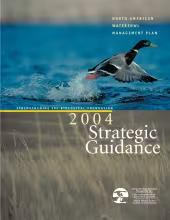
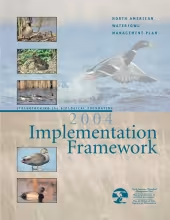
The 2004 Update to the North American Waterfowl Management Plan (NAWMP), titled Strengthening the Biological Foundation, was released in June 2004 (with the Strategic Guidance document published in December 2004). This marked a renewal of commitment 18 years after the original 1986 Plan, following the 1994 inclusion of Mexico and the 1998 Expanding the Vision. Presented in two companion documents...

  1. Strategic Guidance (for partners, administrators, and policymakers)
  2. Implementation Framework (for biologists and land managers)

...it defined needs, priorities, and strategies for the next 15 years (roughly 2004–2019), while emphasizing adaptive, science-driven approaches to address evolving biological, sociological, and economic challenges.

By this point, NAWMP partnerships had achieved remarkable progress, conserving over 13 million acres of wetlands and leveraging more than $3 billion (including $520 million from the North American Wetlands Conservation Act since 1989), with contributions from programs like the U.S. Conservation Reserve Program aiding rebounds in many waterfowl populations under favorable conditions. The update addressed persistent issues such as habitat loss and degradation from urbanization, agriculture, and invasive species, as well as emerging threats like climate change, alongside knowledge gaps (e.g., in boreal forests and sea duck dynamics) and funding constraints. It prioritized strengthening the biological foundation through three interconnected visions:

  • defining and attaining landscape conditions to sustain waterfowl populations via biologically based planning and adaptive management;
  • forging broad alliances with governments, NGOs, indigenous communities, private landowners, and nontraditional sectors to achieve objectives; and
  • continually improving scientific understanding of population-habitat links through monitoring, research, evaluation, and uncertainty reduction.

Population objectives targeted 1970s averages as benchmarks for average conditions, including for ducks (e.g., 8.2 million mallards, 5.6 million northern pintails, 6.3 million lesser/greater scaup, with high priorities for declining species like pintails and scaup), 28 of 34 managed goose populations (e.g., 1–1.5 million mid-continent lesser snow geese, various Canada goose segments), and swan groups (e.g., 80,000 eastern tundra swans). Habitat objectives, set regionally by joint ventures, focused on protection/securing, restoration, and enhancement across 67 areas of continental significance (e.g., Prairie Pothole as top priority for breeding, Western Boreal Forest for scaup/pintails). Examples included Prairie Pothole JV targets of millions of acres in protection and restoration. The adaptive management cycle — iterative planning, implementation, monitoring, and adjustment — guided actions, with joint ventures as key delivery mechanisms, integrating with broader initiatives like the North American Bird Conservation Initiative and global agreements.

The 2004 Strategic Guidance for the North American Waterfowl Management Plan (NAWMP) serves as a renewal of the original 1986 plan, building on updates in 1994 and 1998 to outline needs, priorities, and strategies for the next 15 years. It emphasizes strengthening the biological foundation through sound science, adaptive management, and partnerships across Canada, the United States, and Mexico to sustain waterfowl populations and their habitats for future generations.

The 2004 Implementation Framework for the North American Waterfowl Management Plan (NAWMP), titled "Strengthening the Biological Foundation," serves as a companion to the Strategic Guidance document, providing detailed technical information for biologists and managers to advance waterfowl

Continental Progress Assessment

February 2007

In February 2007, the North American Waterfowl Management Plan (NAWMP) released its first comprehensive continental biological assessment, evaluating 20 years of progress since 1986. Conducted by an international Assessment Steering Committee (ASC) formed in 2005, the report recognized substantial achievements through joint ventures (JVs), including conservation efforts impacting millions of acres for breeding, wintering, and migrating waterfowl, supported by dedicated partners across Canada, the United States, and Mexico. However, it identified persistent challenges, including incomplete habitat goals, variable monitoring and evaluation across JVs, funding constraints, and unmet population objectives amid ongoing threats such as habitat loss.

The assessment emphasized the need for adaptive management and stronger biological foundations, offering key recommendations to clarify population goals, enhance landscape-level planning and policy influence, improve monitoring and research coordination via the NSST, and foster broader alliances for all-bird conservation. It urged periodic assessments to track advancements and called for renewed commitment to achieve abundant, resilient waterfowl populations for future generations.

The North American Waterfowl Management Plan Continental Progress Assessment Final Report represents the first comprehensive continental biological evaluation of the Plan's 20-year history since its inception in 1986. Commissioned by the Plan Committee in 2005, this assessment was led by an international Assessment Steering Committee (ASC) comprising experts from Canada, the United States, and Mexico.

The Future of Waterfowl Management Workshop

August 26-28, 2008

Held in Minneapolis, Minnesota, the Future of Waterfowl Management Workshop marked the first gathering of its kind dedicated to "Framing Future Decisions for Linking Harvest, Habitat, and Human Dimensions." Convened by the North American waterfowl management community and facilitated by DJ Case + Associates, this pivotal event built on decades of innovation — including the Flyway Councils, the North American Waterfowl Management Plan (NAWMP), Adaptive Harvest Management, and the National Duck Hunter Survey — to foster a more integrated, scientifically grounded, and socially responsive framework for waterfowl conservation.

Participants explored ways to enhance coherence across harvest regulations, habitat protection, and human dimensions (such as hunter recruitment, retention, satisfaction, and attitudes), aiming to benefit managers, agencies, and stakeholders alike. Through breakout sessions, presentations, interactive polling, and evaluations, the workshop identified opportunities and challenges for holistic decision-making.

The resulting Summary Report details the proceedings, key findings, and recommended next steps, reinforcing NAWMP's adaptive approach and urging continued collaboration to sustain abundant waterfowl populations amid evolving ecological and societal needs.


2012 NAWMP Revision and Action Plan

December 19, 2012

Marking the 25th anniversary of the original 1986 North American Waterfowl Management Plan (NAWMP), the 2012 Revision — titled People Conserving Waterfowl and Wetlands — delivered a renewed vision for continental waterfowl conservation. This marked the first true revision (not merely an update) since inception, involving fundamental re-examination of goals through extensive consultations with stakeholders across federal, provincial/territorial, state, and NGO partners in Canada, the United States, and Mexico.

Shifting from a primary focus on abundant waterfowl populations via habitat work, the 2012 Plan integrated populations, habitat, and people — emphasizing a growing, supportive core of hunters and viewers, reconnection with nature, and broader societal benefits of wetlands (e.g., water quality, flood control, carbon storage). It outlined seven key recommendations to build an integrated waterfowl management enterprise:

  • revising shared objectives
  • establishing a Human Dimensions Working Group
  • reconnecting people with wetlands
  • prioritizing high-impact landscapes
  • adapting harvest strategies
  • boosting adaptive capacity, and
  • ensuring complementary programs.

The companion 2012 NAWMP Action Plan served as a practical "call to action," offering initial guidance, strategic ideas, and detailed key actions/technical steps to implement the Revision's recommendations. Released alongside trilingual versions (English, French, Spanish), this milestone reinforced NAWMP as a global model for collaborative, adaptive wildlife conservation amid challenges like declining hunter numbers, climate change, urbanization, and fiscal pressures.

This landmark trilateral revision — signed by the environment ministers of Canada, the United States, and Mexico — updates the original 1986 North American Waterfowl Management Plan after 25 years of on-the-ground success.

The 2012 NAWMP Action Plan was published as a companion to the North American Waterfowl Management Plan Revision. It provides strategic guidance and initial steps for implementing the Plan's expanded vision across Canada, Mexico, and the United States. It emphasizes a holistic approach to waterfowl conservation through three interconnected goals:

Cette révision trilatérale historique — signée par les ministres de l’Environnement du Canada, des États-Unis et du Mexique — met à jour le Plan nord-américain de gestion de la sauvagine de 1986 après 25 ans de succès sur le terrain.

Esta revisión trilatéral histórica — firmada por los secretarios de medio ambiente de Canadá, Estados Unidos y México — actualiza el Plan Norteamericano de Manejo de Aves Acuáticas de 1986 después de 25 años de éxitos sobre el terreno.

Revised Objectives: Addendum to the 2012 North American Waterfowl Management Plan

September 2014

The recommendation outlined in the 2012 Revision of the North American Waterfowl Management Plan (NAWMP or Plan) to “Develop, revise or reaffirm NAWMP objectives so that all facets of North American waterfowl management share a common benchmark” presented a timely challenge for the waterfowl management community. Work throughout 2013-14 led to this document, an addendum to the Plan, which outlines revised objectives for waterfowl populations, waterfowl habitat, and those who enjoy and actively support waterfowl and wetlands conservation.

Published in September 2014 by the NAWMP Committee, this milestone document established three integrated goals:

  • Waterfowl Populations - Maintain long-term average (LTA) breeding duck populations (1955–2014 TSA; 1990–2014 ESA) while periodically achieving aspirational peaks of ≥40 million total breeding ducks in the Traditional Survey Area and ≥2.7 million in the Eastern Survey Area.
  • Waterfowl Supporters - Increase active support (hunters, viewers, stamp purchasers, and participating landowners) to at least the levels recorded over the previous two decades.
  • Waterfowl Habitat - Conserve dynamic wetland systems with the capacity to sustain LTA populations, support periodic abundance, and deliver recreation and ecological services.

The addendum emphasizes that true progress requires linking these objectives through adaptive management, Joint Venture landscape planning, human-dimensions surveys, and harvest-policy refinement. It marked a pivotal step in implementing the 2012 Revision and set the stage for the next full NAWMP update in 2024.

The 2012 NAWMP Revision recommended developing, revising, or reaffirming objectives so all facets of waterfowl management share a common benchmark. Work in 2013–14 produced this addendum, which sets revised objectives for populations, supporters, and habitat.

Three integrated goals

2018 North American Waterfowl Management Plan (NAWMP) Update: Connecting People, Waterfowl, and Wetlands

January 2019

This 2018 Update documents progress since the 2012 Revision and 2014 Addendum, reaffirms the three core NAWMP goals, and highlights integrated achievements while charting the path forward.

Reaffirmed Goals and Objectives

  • Populations - Maintain long-term average breeding ducks (TSA 1955–2014; ESA 1990–2014) and periodically achieve ≥40 million (TSA) / ≥2.7 million (ESA).
  • Habitat - Conserve dynamic wetlands capable of sustaining long-term averages, periodic abundance, and recreational/ecological benefits.
  • People - Increase active support (hunters, viewers, landowners) to levels seen in the past two decades.

Key Achievements (2012–2018)

  • Integration - Joint Ventures scaled continental objectives to landscapes; developed decision-support tools (e.g., Upper Mississippi River & Great Lakes JV DST, Priority Landscapes maps) that explicitly balance waterfowl, habitat, and human dimensions.
  • Community examples - Playa Lakes JV (aquifer recharge + municipal partnerships), Intermountain West JV (working ranches), Rainwater Basin JV (public hunting access), San Francisco Bay JV (voter-approved wetland tax), Prairie Habitat JV (economic ROI analysis), Black Duck JV (recreation-site modeling).
  • Continental efforts - NAWMP Human Dimensions Working Group - Public Engagement Team (HDWG-PET) formed; 2017 NAWMP Stakeholder Surveys completed; Public Engagement Strategy launched; Future of Waterfowl II Workshop held; hunter recruitment/retention workshops; institutional review of Plan Committee.

Challenges and Learnings

  • Ongoing threats - habitat loss, climate change, overabundant geese, sea-level rise.
  • Societal disconnect from nature erodes traditional support.
  • New insights from surveys: broad public valuation of wetland benefits (clean water, flood control, recreation); need for adaptive public-engagement frameworks mirroring harvest/habitat models.

Where We’re Going

  • Create “pathways to participation” linking waterfowl conservation to broader societal benefits (health, clean water, sustainable food).
  • Leverage ecosystem services and “green infrastructure” funding.
  • Build adaptive capacity for public engagement using stakeholder data and model-based objectives.

Reflections

The NAWMP’s 32-year success stems from science-based adaptation and partnerships. The 2012 “people” goal has accelerated integration; the community is now poised to broaden support while staying focused on waterfowl.

Eight Recommendations (for 2018–2028)

  1. Focus actions on habitat/population objectives + integrate social science.
  2. Help people understand recreation opportunities and societal benefits.
  3. Compel action to conserve habitat (full stakeholder-survey analysis + engagement strategy by 2020).
  4. Identify priority landscapes for waterfowl and people.
  5. Review/update objectives every 10 years.
  6. Share knowledge to integrate habitat, waterfowl, and people's needs.
  7. Bolster training for future professionals.
  8. Replace Interim Integration Committee with liaisons + ex officio members.

The Update reinforced “think continentally, integrate locally” and positions the NAWMP community to sustain abundant waterfowl, resilient habitats, and growing public support amid changing social-ecological conditions.

2024 Plan Update

December 2024

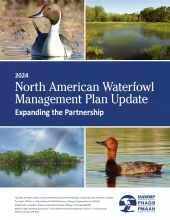
The 2024 Update to the North American Waterfowl Management Plan (NAWMP) built on nearly four decades of collaborative conservation efforts among Canada, the United States, and Mexico. Initiated in 1986 to address declining waterfowl populations, the Plan secured millions of acres of habitat through Joint Ventures and Management Units, demonstrating success in restoring wetlands and supporting biodiversity. Signed by high-level officials from each country, this update reviewed progress since the 2012 Revision and the 2018 Update, emphasizing the Plan's role in providing ecosystem benefits such as improved water quality, flood control, and recreational opportunities.

Despite achievements, the update highlighted ongoing threats, including accelerated wetland and grassland losses — such as a 50% increase in U.S. wetland declines from 2009 to 2019 and rapid grassland conversion in the Northern Great Plains. Human activities, agricultural intensification, urban development, and climate change exacerbate these issues, challenging the sustainability of waterfowl habitats. The Plan called for innovative strategies to scale up conservation, including stronger protections, restoration efforts, and communication of multiple benefits to attract new funding and policy support.

To ensure future success, the update advocated expanding and diversifying partnerships beyond traditional hunters and birders to include Indigenous communities, local governments, farmers, corporations, and others. This broader engagement aims to reverse habitat losses and achieve NAWMP's three core goals:

  • abundant waterfowl populations for hunting and other uses;
  • sufficient wetlands for wildlife and societal benefits; and
  • growing numbers of supporters for conservation.

Published in 2024, this Update reviews progress since the 2018 Update, reaffirms the three core NAWMP goals, and charts a path forward by expanding and diversifying partnerships to reverse ongoing habitat loss and achieve conservation at the scale required.