North American Waterfowl Management Plan Library

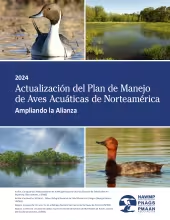
Publicada en 2024, esta Actualización revisa los progresos desde la Actualización de 2018, reafirma los tres objetivos principales del PMAAN y traza la vía a seguir ampliando y diversificando las alianzas para rever
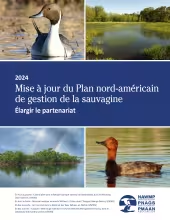
Publiée en 2024, cette mise à jour examine les progrès réalisés depuis la mise à jour de 2018, réaffirme les trois objectifs principaux du PNAGS et trace la voie à suivre en élargissant et en diversifiant les partenariats afin d’inverser les pertes continues d’habitat et d’atteindre la co
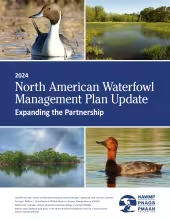
Published in 2024, this Update reviews progress since the 2018 Update, reaffirms the three core NAWMP goals, and charts a path forward by expanding and diversifying partnerships to reverse ongoing habitat loss and achieve conservation at the scale required.


Cette mise à jour examine six années de progrès depuis la Révision de 2012 et l’Addendum de 2014. Elle réaffirme les trois objectifs principaux du PNAGS — des populations de sauvagine abondantes et résilientes, des milieux humides et habitats suffisants, ainsi qu’un nombr


The 2012 NAWMP Revision recommended developing, revising, or reaffirming objectives so all facets of waterfowl management share a common benchmark. Work in 2013–14 produced this addendum, which sets revised objectives for populations, supporters, and habitat.
Three integrated goals

This landmark trilateral revision — signed by the environment ministers of Canada, the United States, and Mexico — updates the original 1986 North American Waterfowl Management Plan after 25 years of on-the-ground success.

Cette révision trilatérale historique — signée par les ministres de l’Environnement du Canada, des États-Unis et du Mexique — met à jour le Plan nord-américain de gestion de la sauvagine de 1986 après 25 ans de succès sur le terrain.

Esta revisión trilatéral histórica — firmada por los secretarios de medio ambiente de Canadá, Estados Unidos y México — actualiza el Plan Norteamericano de Manejo de Aves Acuáticas de 1986 después de 25 años de éxitos sobre el terreno.

The 2012 NAWMP Action Plan was published as a companion to the North American Waterfowl Management Plan Revision. It provides strategic guidance and initial steps for implementing the Plan's expanded vision across Canada, Mexico, and the United States. It emphasizes a holistic approach to waterfowl conservation through three interconnected goals:

The Future of Waterfowl Management Workshop (August 26–28, 2008, Minneapolis, MN) brought together 192 experts, managers, and stakeholders for a groundbreaking summit on linking harvest regulations, habitat conservation, and human dimensions — like hunter satisfaction, recruitment, and broader public support.
Building on NAWMP's legacy of innovation, the event featured dynamic plenaries, breakout discussions, and polling that revealed strong consensus:
The North American Waterfowl Management Plan Continental Progress Assessment Final Report represents the first comprehensive continental biological evaluation of the Plan's 20-year history since its inception in 1986. Commissioned by the Plan Committee in 2005, this assessment was led by an international Assessment Steering Committee (ASC) comprising experts from Canada, the United States, and Mexico.

The North American Waterfowl Management Plan Continental Progress Assessment Final Report represents the first comprehensive continental biological evaluation of the Plan's 20-year history since its inception in 1986. Commissioned by the Plan Committee in 2005, this assessment was led by an international Assessment Steering Committee (ASC) comprising experts from Canada, the United States, and Mexico.
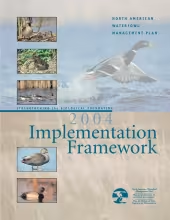
The 2004 Implementation Framework for the North American Waterfowl Management Plan (NAWMP), titled "Strengthening the Biological Foundation," serves as a companion to the Strategic Guidance document, providing detailed technical information for biologists and managers to advance waterfowl
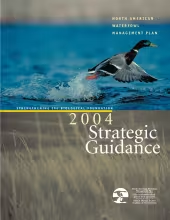
The 2004 Strategic Guidance for the North American Waterfowl Management Plan (NAWMP) serves as a renewal of the original 1986 plan, building on updates in 1994 and 1998 to outline needs, priorities, and strategies for the next 15 years. It emphasizes strengthening the biological foundation through sound science, adaptive management, and partnerships across Canada, the United States, and Mexico to sustain waterfowl populations and their habitats for future generations.

The 1998 Update to the North American Waterfowl Management Plan (NAWMP), titled Expanding the Vision, built upon the foundational 1986 agreement signed by Canada and the United States, as well as Mexico's inclusion as a signatory in 1994. This update advanced a truly continental conservation effort by reflecting on the Plan's early legacy — where partnerships had already conserved over 5 million acres of wetlands through innovative public-private collaboration — and by addressing a rapidly changing socioeconomic context.

The North American Waterfowl Management Plan, released in May 1986, served as a cooperative strategy between Canada and the United States to conserve ducks, geese, and swans across the continent, emphasizing the protection and restoration of wetlands amid ongoing habitat loss from agriculture, urbanization, and other human activities.

The 1994 Update to the North American Waterfowl Management Plan, titled "Expanding the Commitment," marks the first revision of the 1986 Plan, extending its vision through 2001 and beyond while incorporating Mexico as a full partner alongside Canada and the United States. This trinational accord reaffirms the Plan's core purpose: to restore waterfowl populations through wetland ecosystem management, conserve biological diversity in the Western Hemisphere, integrate wildlife conservation with sustainable economic development, and foster public-private partnerships.