Webinars

Webinars

Webinars

Hunter fates to harvest rates: Integrating hunter behavior to inform waterfowl harvest management
January 28, 2026

Richard Berl, Research Scientist
USGS National Wildlife Health Center

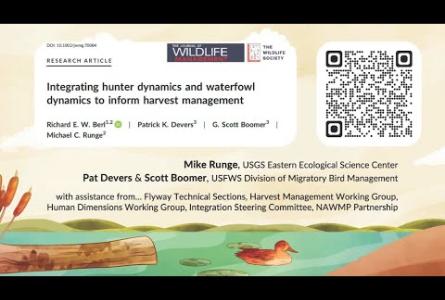
The conservation of waterfowl in North America depends not only on healthy waterfowl populations and habitats, but also on the support of hunters and other conservationists; yet, the number of active hunters has been in steady decline over recent decades. To aid understanding and management of the complexity of the interconnected waterfowl-hunter-harvest system, Berl et al. (2025, J Wildl Manage) developed a modeling framework that links the population dynamics and behaviors of hunters with those of waterfowl populations over time. This framework enables predictions of how changes in harvest regulations, cultural values, or hunter R3 and participation patterns might affect game species and people, offering a more complete picture for future management decisions and progress toward integrating social objectives as the third pillar of waterfowl conservation across North America.

Mid Continent Light Geese – Still Presenting Challenges
August 15, 2025

Mark Vrtiska, Professor of Practice
University of Nebraska-Lincoln
Coordinator, Tern and Plover Conservation Partnership

In the mid- to late 1990s, the mid-continent population of light geese (lesser snow and Ross’s geese) presented managers with a unique challenge in wildlife management, due to their overabundance and effects on northern habitats. The issue was highlighted at national levels and entailed an unprecedented marketing campaign to disseminate information to the hunting and non-hunting public about the problem and potential solutions. The main solution implemented was the Light Goose Conservation Order (LGCO) that allowed the use of special measures previously deemed illegal, with the goal of reducing the population by half. The LGCO has persisted over the past 25 years, despite evidence that it has not had the intended effect on the population. Since about 2015, the mid-continent light geese population has been declining and is currently near levels where management actions may be required. Possible changes to either the LGCO or regular hunting seasons may require another effort to inform interested constituencies about the current status of the mid-continent population of light geese.